Philippe Sauzedde: Half a Century Connecting Japan and France
Service Means Sensing What a Guest Wants
Since arriving in Japan in 1974, Philippe Sauzedde has introduced Japanese audiences to French cuisine, cheese, wine, Calvados and Champagne. In 1982, he served Emperor Shōwa at the French Embassy during President François Mitterrand’s visit. Today, he shares French culture through social media. We spoke with him about hospitality and the art de vivre he holds dear.
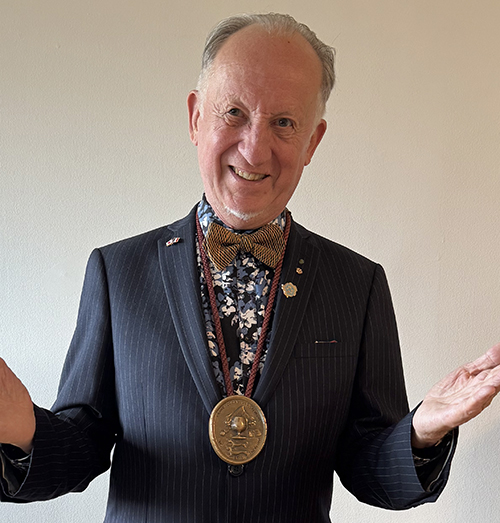
How did your connection with Japan begin?
In 1964, when I was 11, my younger brother and I were playing in a park in Moulins-sur-Allier. A group of Japanese men walked by, and one asked me for an address in English. I helped him. A month later, a postcard arrived from Japan asking if I would like to be pen pals.
After I arrived in Japan, I learned that Mr. Asakura owned Hillside Terrace in Daikanyama. That connection helped me find somewhere to live while I studied Japanese at the Naganuma School in Shibuya. I came to Japan in 1974. Life is mysterious, isn’t it? A small encounter eventually brought me here.
How did Japanese guests enjoy French restaurants when you began working in Tokyo?
Approachable dishes such as escargots, sole meunière, coq au vin, and beef stew were popular. We brought fish or meat on the bone to the table on a trolley, then carved it, flambéed it with Pernod, or finished the sauce before the guests. You rarely see that kind of tableside service now. At the time, people enjoyed the presentation and conversation as much as the food.
I wanted guests to return. You need to sense what they feel like drinking and the mood they are in. A service professional has to be a bit of a psychologist.
Without wishing to boast, I was a pioneer among head waiters in introducing cheese platters to restaurant guests. I sought out unusual cheeses, explained them, and suggested something to accompany a wine they liked. Only a few restaurants presented a wide selection of cheeses on a large tray at the table. My aim was to help guests discover a new pleasure, not to display my knowledge. Challenges like that made restaurant work exciting.
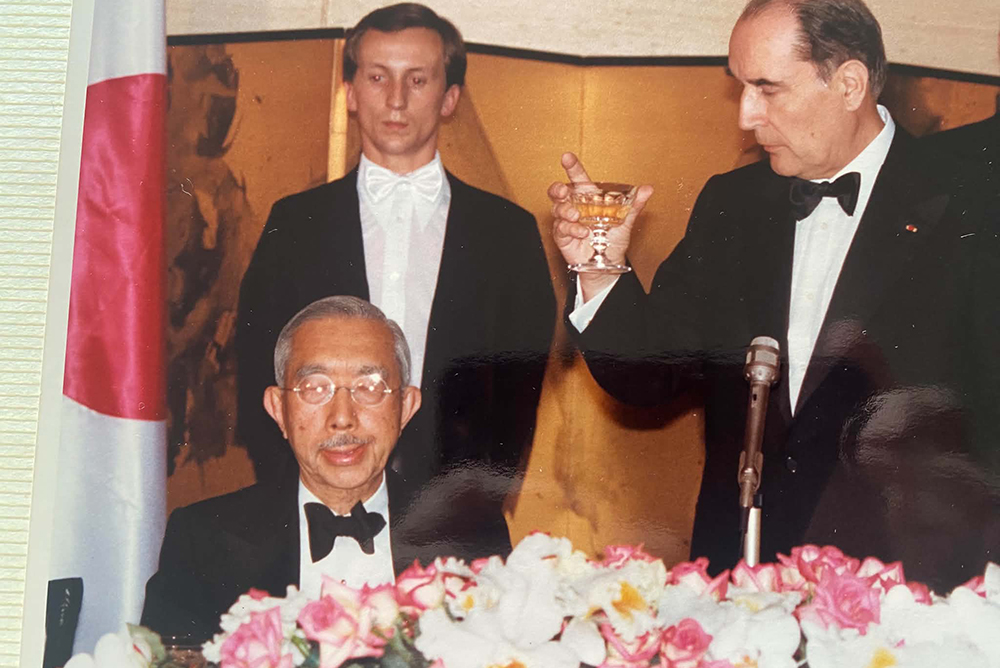 Philippe Sauzedde, serving Emperor Shōwa and President Mitterrand at the French Embassy in Tokyo, April 1982, during Mr. Xavier Daufresne de La Chevalerie’s tenure as ambassador
What do you remember about serving Emperor Shōwa in 1982?
The French ambassador often dined at the restaurant where I worked. Because he trusted my service, I was assigned to attend to Emperor Shōwa during President Mitterrand’s visit.
I stood behind the Emperor for nearly five hours and helped carve his food. The menu featured illustrations of French scenes. Because I spoke Japanese, he asked me about them directly. I was extremely nervous, but that conversation remains unforgettable.
How has the way people enjoy Champagne in Japan changed?
Champagne was once mainly for wedding toasts and celebrations. Its popularity later grew, particularly among women. I was among the first ambassadors to promote it in Japan, working for 22 years with Laurent-Perrier and later eight years with Dom Pérignon. For 30 years, I have been saying it is for more than a toast.
You can choose Champagne to suit your mood, the food or the person you are with. A rosé might suit a festive occasion; someone who enjoys a very dry style might prefer another cuvée. Each has its own character, and Champagne can accompany an entire meal. I am delighted that more people now see it as something that shapes an occasion.
How has Japanese understanding of French food culture changed?
French cuisine once seemed expensive and intimidating. Today, people also enjoy it casually in brasseries and bistros. They are more curious about cheese, wine, and unfamiliar flavors.
Many French restaurants in Japan offer only set menus. A course lets a chef express a vision, but guests should also be able to choose à la carte according to their appetite and mood. French cuisine includes both haute cuisine and comforting home-style stews. I would love more people to discover that freedom.
What differences do you see between French hospitality and Japanese omotenashi?
Japanese service is wonderfully courteous and reliable, with attention to every detail. Sometimes, however, it becomes a little formal. Instead of greeting everyone with the same “Irasshaimase,” you could welcome a guest you know by name. That small change can make a great difference.
French service emphasizes conversation, though it does not have to be long. The skill is in asking what guests hope for, how they feel that day, and what they would like to eat. Remembering what they ordered last time can help you suggest something new. Personal connections bring guests back.
Combining Japanese precision and courtesy with French conversation and personal attention would make hospitality even better.
 Philippe Sauzedde performing sabrage with Laurent-Perrier Champagne before French President Jacques Chirac, 1998
What would you like to pass on to the next generation?
In training, I describe a triangle: passion at the top, knowledge and love at the foundation, and energy at the center. Passion grows from knowing and caring about food, wine, guests, and colleagues.
Even when preparing a fish, you can think, “I want to clean this carefully and present it beautifully.” You make a sauce because you want it to taste delicious. That care comes through in the food and service. Restaurant work is demanding, but guests return, remember your name, and compliment you. Feeling that joy makes work and life more enjoyable.
After more than half a century in Japan, how do you see your identity?
My soul is French. I love sharing our dining customs and art de vivre. Perhaps I am 60 percent French and 40 percent Japanese. I have embraced what I love about Japan and brought the two cultures together.
I now share my experiences on YouTube, where I have 83,500 followers and some videos have reached 29 million views, and on Instagram, TikTok, and Facebook. Many people in Japan send me kind messages. Their warmth means a great deal to me. I started because I wanted to feel closer to people in Japan and build a bridge between our countries, more than for financial reasons. I am deeply grateful to Japan. That is why I cannot leave it behind. I want to keep sharing French culture with a smile and cherish the connections I have made here.